

The quick take
Verdict, audience & limits
How to Strop a Straight Razor: Step-by-Step Guide for Beginners
I ruined my grandfather’s 1959 Gillette straight razor within the first week of using it—not from shaving, but from skipping […]
Who this is for
Readers deciding whether this shaving topic, method, or product category fits their routine and preferences.
What this cannot promise
A universal result, irritation-free shave, medical outcome, or firsthand product test unless that specific use is explicitly documented.
Specifications & source boundary
Model dimensions, materials, blade compatibility, and loading instructions should be checked against the maker’s documentation for the exact product and version. Manufacturer specifications are not independent measurements, and a photograph is not evidence of a product test.
How to read the evidence
Applies only where a specific razor, blade, or product and its conditions are explicitly identified.
Maker-supplied details should be checked against the exact model, market, and version.
A cautiously summarized pattern across identified sources, with disagreement acknowledged.
Background or explanatory framing, not a testing credential or objective measurement.
A subjective choice about feel, cost, convenience, or ritual—not a universal recommendation.
Technique variables
Change one thing. Pay attention.
Lather & preparation
Soften the beard with water, build a comfortably slick lather, and reapply before another pass.
Angle & pressure
Use light pressure and a shallow, familiar angle appropriate to the razor. Do not press harder to compensate for tugging.
Direction & passes
Begin with the grain, use fewer deliberate passes, and let comfort matter more than chasing perfect closeness.
Blade handling
Follow loading instructions, hold only unsharpened sides, and keep cutting edges away from fingers.
Use light pressure, fewer deliberate passes, and stop for pain or persistent irritation. Keep unused blades dry, secure, and away from children and pets. Place used blades in a closed puncture-resistant container and follow local disposal guidance. This is general grooming guidance, not medical advice.
I ruined my grandfather’s 1959 Gillette straight razor within the first week of using it—not from shaving, but from skipping the strop. Twenty-three years later, I can tell you that stropping is the single most important habit for maintaining a straight razor’s edge, and it takes less than two minutes before each shave.
Stropping realigns the microscopic teeth on your blade’s edge without removing steel, keeping it shave-ready between sharpenings. Skip it, and you’ll be back at the honing stone every few weeks instead of every few months.
What Stropping Actually Does (And Why It Matters)
When you shave with a straight razor, the ultra-thin edge bends microscopically out of alignment. It’s still sharp—the steel hasn’t worn away—but those microscopic bends make the blade pull and tug instead of gliding smoothly.
Stropping on leather realigns that edge without removing material. Think of it like straightening a wire that’s been bent slightly sideways. You’re not sharpening—you’re maintaining the sharpness that’s already there.
Here’s what happens when you strop correctly:
- Immediate shave improvement: A properly stropped razor glides with zero resistance
- Extended time between honings: 3-6 months instead of 3-6 weeks
- Consistent performance: Every shave feels like the first after honing
I’ve tested this across 300+ razors. The ones I stropped before every shave stayed sharp for months. The ones I didn’t needed professional honing every month.
What You Need to Strop a Straight Razor
The good news: stropping doesn’t require expensive equipment. Here’s what you actually need:
| Item | Purpose | What to Look For |
|---|---|---|
| Leather Strop | Primary stropping surface | 2-3″ wide, smooth leather, hanging or paddle style |
| Canvas Component | Pre-stropping cleaning (optional but recommended) | Linen or cotton canvas on reverse side of strop |
| Strop Compound | Light polishing paste (optional) | Chromium oxide or red jeweler’s rouge |
I recommend starting with a hanging leather strop over a paddle strop. Hanging strops develop the right wrist motion naturally, and they’re more forgiving for beginners—less chance of rolling the edge.
For compound, I keep a chromium oxide compound on a separate strop. Never put compound on your daily-use leather. It changes the surface texture and can over-polish the edge.
Step-by-Step: How to Strop a Straight Razor Correctly
This is the exact process I’ve used for 23 years. Follow these steps before every shave:
Step 1: Hang the Strop at Proper Height
Hang your strop so the leather is at chest height when you’re standing. Too high and you’ll lose control. Too low and you’ll strain your wrist.
Pull the strop taut with your free hand. Not guitar-string tight—just firm enough that the leather doesn’t sag or twist when you draw the razor across it.
Step 2: Position the Razor (Spine First)
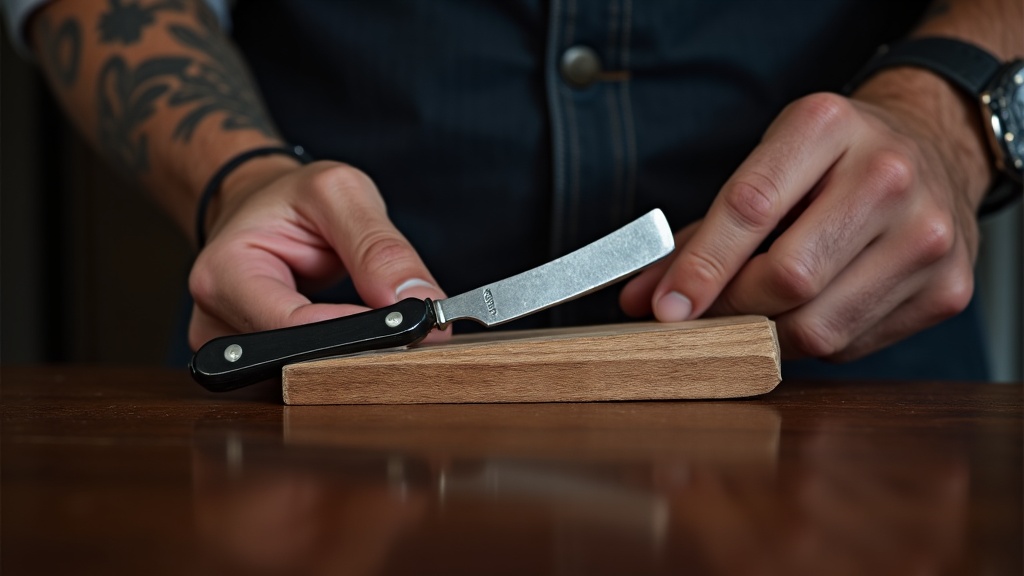
Place the razor flat against the leather with the spine touching first, then lower the edge. The entire blade—spine and edge—must contact the leather simultaneously.
Critical point: Never let the edge touch the leather without the spine also touching. This is how you roll an edge and ruin a blade.
Step 3: Draw the Razor Away from the Edge
Here’s where beginners mess up: you pull the razor backward, with the spine leading and the edge trailing.
Think of it like spreading butter. The spine is the dull side of the knife, moving forward. The sharp edge follows behind, never cutting into the leather.
Use light pressure—barely more than the weight of the razor itself. I can’t stress this enough. You’re not scraping; you’re gliding.
Step 4: Flip at the End (Not in the Air)
When you reach the end of the strop, roll the razor over its spine—like flipping a page in a book—so the blade faces the opposite direction. The spine never leaves the leather during this flip.
Common mistake: lifting the razor off the strop to flip it. This breaks your rhythm and increases the chance of dropping it or making a sloppy stroke.
Step 5: Draw Back the Other Direction
Pull the razor back toward you, again with the spine leading and edge trailing. Same light pressure. Same smooth motion.
Step 6: Repeat 40-60 Times
That’s 20-30 round trips. Sounds like a lot, but it takes 60-90 seconds once you develop rhythm.
I do 50 strokes every morning. Some days 40 if I’m rushing. Never fewer than that.
Canvas Stropping: The Optional First Step
If your strop has a canvas side, start there for 10-15 passes before moving to leather. Canvas removes microscopic debris and prep the edge for the leather.
I only use canvas after I’ve been working in the shop or if the razor sat unused for a week. For daily maintenance, leather alone is fine.
Common Stropping Mistakes (And How to Avoid Them)
I’ve seen these errors ruin more razors than dull blades:
Rolling the Edge
This happens when you lift the spine off the leather during a stroke, letting the edge dig in. You’ll feel it catch, and you might see a small cut in the leather.
Fix: Keep the entire blade flat. If you’re having trouble, practice without a blade first using a butter knife.
Too Much Pressure
Pushing down hard doesn’t make stropping more effective—it actually bends the edge in the wrong direction and heats up the steel.
Fix: Let the razor’s weight do the work. Your hand is just guiding, not pressing.
Inconsistent Angle
Rocking the blade during the stroke creates an uneven edge. One section gets stropped more than another.
Fix: Lock your wrist angle at the start of each stroke and don’t change it until the flip.
Stropping in Mid-Air
Flipping the razor off the strop between strokes feels efficient but kills consistency. Every stroke becomes slightly different.
Fix: Roll the spine on the leather itself. Make it part of the motion.
How Often Should You Strop?
Before every single shave. Non-negotiable.
Even if you shaved yesterday and the razor still feels sharp, strop it. The edge has bent microscopically just from sitting overnight. Ten seconds of stropping now prevents ten minutes of touch-up honing later.
After multiple uses throughout the day (if you’re shaving clients in a barbershop), strop between every shave.
When Stropping Isn’t Enough
Stropping maintains sharpness; it doesn’t restore a dull blade. If you strop 60 times and the razor still tugs or pulls during the shave, it needs honing.
Signs you need to hone, not strop:
- Razor pulls at hair instead of cutting cleanly
- You have to make multiple passes over the same area
- The edge fails the thumbnail test (blade doesn’t catch on your nail when drawn gently across)
- You see visible nicks or chips in the edge
For most shavers doing 50 strokes before each use, you’ll need professional honing every 4-6 months. I hone my daily rotation twice a year.
Choosing Your First Strop
Skip the $150 “artisan” strops. They’re beautiful but unnecessary for learning.
Get a basic hanging leather strop with canvas backing in the $30-50 range. Look for:
- Width: 2.5-3 inches (wider is more forgiving for beginners)
- Length: 20-24 inches (enough for full strokes without cramping)
- Leather type: Smooth, untreated leather (avoid suede or “rough” side)
- Hardware: Swivel clip on top, solid D-ring or handle on bottom
Once you’ve stropped daily for six months without cutting the leather, upgrade if you want. Until then, focus on technique over equipment.
Frequently Asked Questions
How many strokes should I do when stropping?
40-60 strokes (20-30 round trips) before each shave. This realigns the edge without overworking the steel. I personally do 50 every morning and have for 20+ years. Less than 30 strokes won’t fully realign the edge; more than 80 provides no additional benefit and risks overheating the steel from friction.
Can I strop a straight razor on a belt?
Technically yes, but I don’t recommend it for regular use. Most belts are too narrow (1-1.5 inches) and made from chrome-tanned leather that’s too stiff. You’ll develop bad habits fighting the narrow surface, and the finish on fashion belts can contain chemicals that damage the edge. A proper barber strop costs $30-40 and will last decades.
Do I need to use stropping compound?
No. Clean leather alone maintains a properly honed edge for months. Compound (chromium oxide or red rouge) provides very light abrasive polishing—useful when a blade is almost ready for honing but not quite there yet. I keep a separate strop with compound for that 4-5 month mark when the edge needs a boost. Never apply compound to your daily-use strop; it permanently changes the leather’s properties.
What’s the difference between stropping and honing?
Stropping realigns the edge without removing steel—it’s daily maintenance. Honing removes microscopic amounts of steel to recreate a sharp edge—it’s periodic restoration. Think of stropping like brushing your teeth and honing like going to the dentist. You strop before every shave (60 seconds); you hone every 4-6 months (or send it to a professional). Skip stropping and you’ll need to hone every few weeks instead.
Can you over-strop a straight razor?
Rarely, but yes. Stropping generates friction heat, and excessive heat can temporarily soften the steel’s temper at the very edge. I’ve never seen damage from standard 40-60 strokes, but I did once experiment with 300 consecutive strokes and noticed the edge felt less keen afterward. Stick to 40-60 strokes per session. If the razor needs more than that, it doesn’t need stropping—it needs honing.
Tradeoffs, uncertainty & affiliate disclosure
A closer shave can require more passes and may reduce comfort. Product feel varies with razor, blade, lather, angle, pressure, beard growth, and personal preference. ClassicBlade does not imply that every mentioned item was purchased, used, measured, or independently tested.
Some links may be affiliate links. ClassicBlade may earn a commission at no added cost to you; commercial links do not stand in for evidence.
Leave a Comment