
The quick take
Verdict, audience & limits
Best Open Comb Safety Razors: Top Models Ranked for Heavy Beards
Open Comb vs Closed Comb Safety Razors: A Complete Comparison Guide After testing over 300 safety razors in 23 years […]
Who this is for
Readers deciding whether this shaving topic, method, or product category fits their routine and preferences.
What this cannot promise
A universal result, irritation-free shave, medical outcome, or firsthand product test unless that specific use is explicitly documented.
Specifications & source boundary
Model dimensions, materials, blade compatibility, and loading instructions should be checked against the maker’s documentation for the exact product and version. Manufacturer specifications are not independent measurements, and a photograph is not evidence of a product test.
How to read the evidence
Applies only where a specific razor, blade, or product and its conditions are explicitly identified.
Maker-supplied details should be checked against the exact model, market, and version.
A cautiously summarized pattern across identified sources, with disagreement acknowledged.
Background or explanatory framing, not a testing credential or objective measurement.
A subjective choice about feel, cost, convenience, or ritual—not a universal recommendation.
Technique variables
Change one thing. Pay attention.
Lather & preparation
Soften the beard with water, build a comfortably slick lather, and reapply before another pass.
Angle & pressure
Use light pressure and a shallow, familiar angle appropriate to the razor. Do not press harder to compensate for tugging.
Direction & passes
Begin with the grain, use fewer deliberate passes, and let comfort matter more than chasing perfect closeness.
Blade handling
Follow loading instructions, hold only unsharpened sides, and keep cutting edges away from fingers.
Use light pressure, fewer deliberate passes, and stop for pain or persistent irritation. Keep unused blades dry, secure, and away from children and pets. Place used blades in a closed puncture-resistant container and follow local disposal guidance. This is general grooming guidance, not medical advice.
Open Comb vs Closed Comb Safety Razors: A Complete Comparison Guide
After testing over 300 safety razors in 23 years of wet shaving, I can tell you this: the difference between open comb and closed comb razors isn’t about which is “better”—it’s about which matches your beard and skill level. An open comb gives you more blade exposure and works brilliantly on thick growth, while a closed comb offers forgiveness and control for daily shaving.
I remember the first time I picked up my grandfather’s 1959 Gillette Fatboy. It was a closed comb, smooth as butter, perfect for learning. Years later, when I grew out a week’s stubble on a camping trip, that same razor struggled. That’s when I discovered open comb razors—and realized why both designs have survived over a century of innovation.
What Is a Closed Comb Safety Razor?
A closed comb safety razor (also called a safety bar razor) has a solid, continuous bar that runs along the edge of the blade. This bar sits between your skin and the blade’s cutting edge, creating a protective barrier that limits how much blade actually contacts your face.
Think of it like training wheels on a bicycle. The safety bar does three things:
- Stretches the skin slightly before the blade makes contact
- Limits blade exposure, reducing the angle at which the blade can cut
- Controls pressure by preventing you from applying too much force
Most modern safety razors are closed comb designs. The Merkur 34C heavy duty safety razor and Edwin Jagger DE89 chrome plated razor are both closed comb razors that I recommend to beginners weekly.
The closed comb design has been the standard since Gillette’s original safety razor patents in the early 1900s. It’s comfortable, predictable, and difficult to mess up—which is exactly what most shavers need for daily use.
What Is an Open Comb Safety Razor?
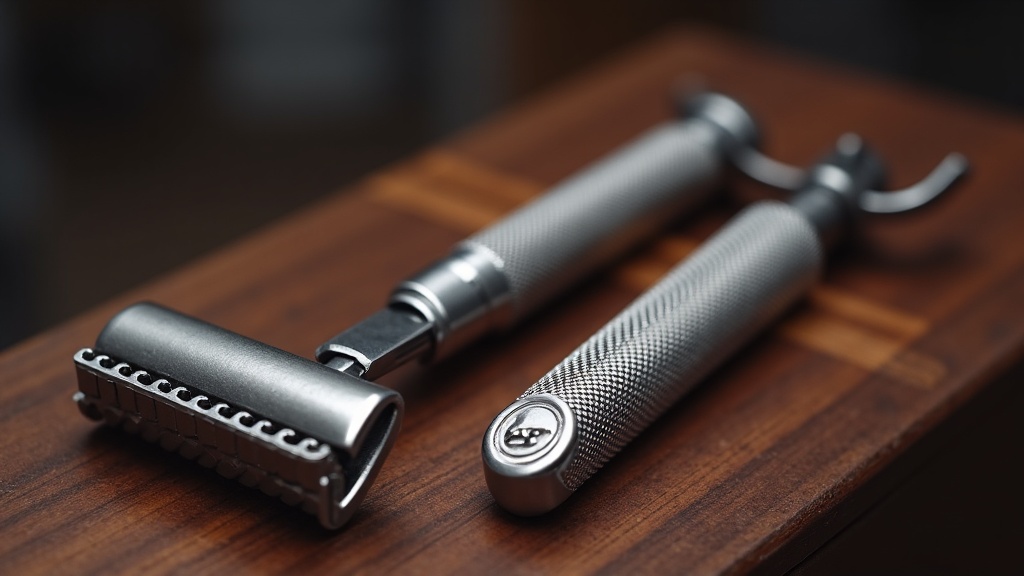
An open comb safety razor replaces that solid safety bar with a serrated, comb-like guard. Instead of a continuous barrier, you get individual teeth that channel lather and cut hair while allowing more direct blade contact with your skin.
The teeth serve a specific purpose:
- Guide longer hairs toward the blade edge (crucial for heavy stubble)
- Channel lather and cut whiskers away from the cutting path
- Increase blade exposure, allowing a more aggressive cut
- Provide tactile feedback so you feel exactly what the razor is doing
Open comb razors were actually the original design. The vintage Gillette Old Type safety razor from 1904 featured an open comb because men in that era often shaved less frequently—sometimes only once or twice a week.
Today, open comb razors are considered specialty tools for specific situations. The Mühle R41 open comb safety razor is legendary among enthusiasts, though it’s absolutely not where I’d tell a beginner to start.
Key Differences: Open Comb vs Closed Comb
Here’s how these two designs stack up in real-world use:
| Feature | Closed Comb | Open Comb |
|---|---|---|
| Blade Exposure | Minimal—safety bar limits contact | Greater—teeth allow more direct contact |
| Best For | Daily shaving, 1-2 days growth | Heavy stubble, 3+ days growth |
| Skill Level | Beginner-friendly | Intermediate to advanced |
| Irritation Risk | Lower—more forgiving | Higher if used incorrectly |
| Efficiency | Moderate—may need multiple passes | High—cuts more per pass |
| Clogging | Can clog with heavy growth | Resists clogging—channels debris away |
| Tactile Feedback | Smooth, less feedback | You feel every whisker cut |
Which One Should You Choose?
The honest answer depends on your beard type, shaving frequency, and experience level. Here’s how I guide people through the decision:
For Beginners: Start With Closed Comb
If you’re new to safety razors, a closed comb is the right choice 95% of the time. The safety bar compensates for inconsistent blade angle and excessive pressure—two mistakes every beginner makes.
I learned on a closed comb. My son learned on a closed comb. Every student I’ve taught wet shaving has started with a closed comb. The muscle memory you build with a forgiving razor translates perfectly when you’re ready to try something more aggressive.
Go with a Merkur closed comb safety razor or similar mid-tier option. Learn proper technique first, then experiment later.
For Experienced Shavers: Consider Both
Once you’ve been wet shaving for six months or more, an open comb makes sense as a second razor. I keep both in my rotation:
- Daily shaves (1-2 days growth): Closed comb every time. It’s faster, smoother, and there’s no reason to use a more aggressive tool when you don’t need it.
- Weekend or travel shaves (3+ days growth): Open comb. It cuts through heavy stubble in fewer passes, reducing overall irritation.
- Head shaving: Open comb. The increased efficiency matters when you’re covering that much surface area.
The Fatip open comb safety razor is an excellent entry point into open comb shaving—aggressive but not punishing.
For Thick or Coarse Beards: Open Comb Can Help
If you have genuinely coarse facial hair—the kind that dulls blades in two shaves and laughs at cartridge razors—an open comb might become your daily driver sooner than most.
The increased efficiency means fewer passes, which often translates to less irritation despite the more aggressive design. But you need to earn this. Use light pressure, maintain proper blade angle (about 30 degrees), and don’t rush.
I’ve seen guys with thick beards get phenomenal results from open comb razors. I’ve also seen them draw blood because they approached the tool without respect. The razor doesn’t care about your beard type if your technique is sloppy.
Common Myths About Open Comb vs Closed Comb
Myth: “Open comb razors are always more aggressive.”
Not true. Aggressiveness is determined by blade gap and blade exposure—design factors independent of the comb style. The Parker 24C open comb safety razor is milder than many closed comb razors. Conversely, the Merkur 37C is a closed comb slant razor that’s brutally aggressive.
The comb design affects how the razor handles long hair, not necessarily how aggressively it cuts.
Myth: “Closed comb razors can’t handle thick beards.”
Wrong. They’re less efficient on heavy growth, but they absolutely work. I shaved with only closed comb razors for the first decade of my wet shaving journey, including plenty of weekend stubble. You might need an extra pass or two, but the results are identical.
Myth: “You’ll eventually ‘graduate’ to open comb.”
This isn’t a progression system. Plenty of expert shavers prefer closed comb razors for daily use because they’re comfortable and efficient for normal growth. Using an open comb doesn’t make you a better shaver—it makes you someone who uses an open comb.
Frequently Asked Questions
Can you use the same blades in open comb and closed comb razors?
Yes, absolutely. Both designs use standard double-edge (DE) blades. The blade is identical—only the guard design differs. Your Feather razor blades or Astra Superior Platinum blades work in any standard DE razor regardless of comb type.
Is an open comb razor more likely to cut you?
Only if you use poor technique. An open comb razor with proper blade angle and light pressure is perfectly safe. The danger comes from applying cartridge razor habits—pressing hard and using steep angles—to a tool that doesn’t tolerate those mistakes. Respect the design and you’ll be fine.
Do open comb razors work better for shaving your head?
Many head shavers prefer open comb razors because they’re more efficient over large surface areas and less prone to clogging. That said, I know bald guys who swear by closed comb razors. Try both if head shaving is your primary use case—it’s very individual.
How often should you shave to use a closed comb effectively?
Closed comb razors work best with daily to every-other-day shaving schedules. Once you’re past three days of growth, they become less efficient (though still functional). If you regularly go 4+ days between shaves, keep an open comb razor on hand for those situations.
Are vintage open comb razors better than modern ones?
Not necessarily. Vintage open comb razors like the Gillette Old Type or NEW are excellent designs, but modern manufacturers have refined the geometry and metallurgy. A new RazoRock open comb safety razor will perform just as well as a 1920s Gillette—and you won’t worry about damaging a collectible piece.
Tradeoffs, uncertainty & affiliate disclosure
A closer shave can require more passes and may reduce comfort. Product feel varies with razor, blade, lather, angle, pressure, beard growth, and personal preference. ClassicBlade does not imply that every mentioned item was purchased, used, measured, or independently tested.
Some links may be affiliate links. ClassicBlade may earn a commission at no added cost to you; commercial links do not stand in for evidence.



Leave a Comment