


The quick take
Verdict, audience & limits
Can You Bring a Straight Razor on a Plane?
My grandfather’s razor is what got me started, and after 23 years of wet shaving and more than 300 razors […]
Who this is for
Readers deciding whether this shaving topic, method, or product category fits their routine and preferences.
What this cannot promise
A universal result, irritation-free shave, medical outcome, or firsthand product test unless that specific use is explicitly documented.
Specifications & source boundary
Model dimensions, materials, blade compatibility, and loading instructions should be checked against the maker’s documentation for the exact product and version. Manufacturer specifications are not independent measurements, and a photograph is not evidence of a product test.
How to read the evidence
Applies only where a specific razor, blade, or product and its conditions are explicitly identified.
Maker-supplied details should be checked against the exact model, market, and version.
A cautiously summarized pattern across identified sources, with disagreement acknowledged.
Background or explanatory framing, not a testing credential or objective measurement.
A subjective choice about feel, cost, convenience, or ritual—not a universal recommendation.
Technique variables
Change one thing. Pay attention.
Lather & preparation
Soften the beard with water, build a comfortably slick lather, and reapply before another pass.
Angle & pressure
Use light pressure and a shallow, familiar angle appropriate to the razor. Do not press harder to compensate for tugging.
Direction & passes
Begin with the grain, use fewer deliberate passes, and let comfort matter more than chasing perfect closeness.
Blade handling
Follow loading instructions, hold only unsharpened sides, and keep cutting edges away from fingers.
Use light pressure, fewer deliberate passes, and stop for pain or persistent irritation. Keep unused blades dry, secure, and away from children and pets. Place used blades in a closed puncture-resistant container and follow local disposal guidance. This is general grooming guidance, not medical advice.
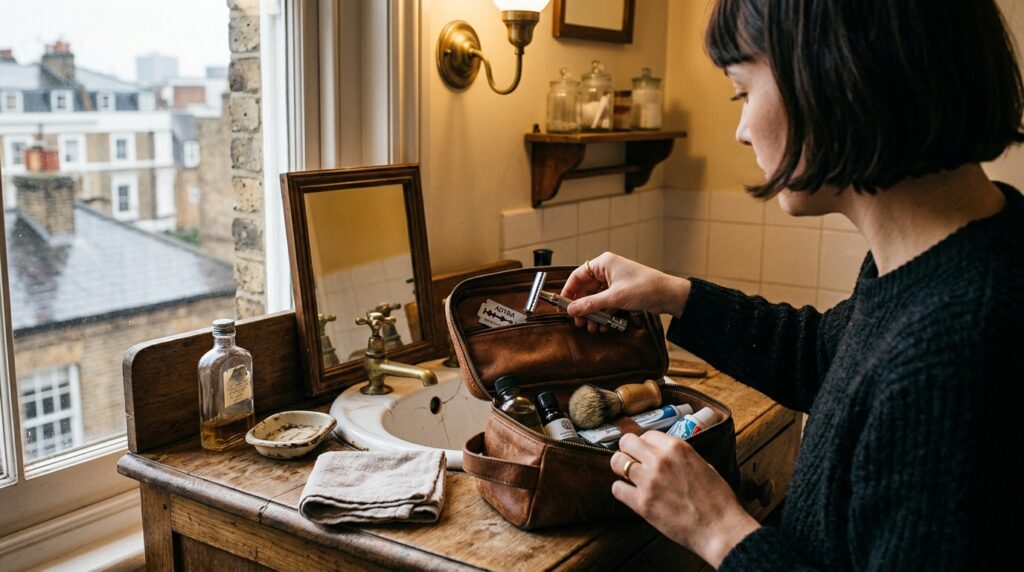
My grandfather’s razor is what got me started, and after 23 years of wet shaving and a collection of 300+ razors owned or handled, I still think about what cannot be replaced before packing a shaving kit. Can you bring a straight razor on a plane? Yes, in checked baggage. A traditional straight razor cannot go in your carry-on. Closing it inside its scales or putting it in a handsome leather case does not change that distinction.
For a short trip with hand luggage only, take a cartridge razor or an electric shaver. If you are checking a bag and want your usual straight-razor shave, the job is to protect the person inspecting the bag, the fragile cutting edge, and the old materials around it. Those are three separate concerns, and a loose razor wrapped in a washcloth handles none of them especially well.
As an Amazon Associate, I earn from qualifying purchases through links in this article.
What the razor rules mean for your shaving kit
The useful distinction is whether you have an exposed or removable blade. TSA’s razor entries in its prohibited-items guide distinguish cartridge razors from loose blades and require an empty safety razor at the checkpoint. Here is the practical packing comparison for U.S. screening:
| Razor type | Carry-on | Checked baggage |
|---|---|---|
| Traditional straight razor | No | Yes; protect the blade |
| Double-edge safety razor | Yes, without blade | Yes |
| Loose double-edge or single-edge blades | No | Yes; securely contained |
| Disposable or cartridge razor | Yes | Yes |
| Electric shaver | Yes | Yes; check applicable battery requirements |
Remove a safety razor’s blade before screening; the officer will not do that job for you. Sharp items in checked luggage must be sheathed or securely wrapped to prevent injury. The screening officer makes the final checkpoint decision.
A shavette needs its own answer
A shavette holds a replaceable blade in a straight-razor-style holder. Do not assume the allowance for an empty double-edge safety razor covers that holder. My packing recommendation is to check the shavette and its blades, or get model-specific guidance from AskTSA before choosing a carry-on kit. A product listing that says ?travel razor? does not resolve the question.
Choose the razor you can afford to have delayed or damaged
I would leave my grandfather’s razor at home for an ordinary business trip. That is not a judgment on its shaving ability; it is a judgment on replacement. A delayed suitcase is inconvenient with a current-production razor. With an heirloom, the same suitcase carries a problem no refund can properly settle.
A sensible traveling straight razor closes centrally, has sound scales, and has enough pivot tension to stay closed during normal handling. Check it in good light before you pack. If the edge approaches one scale as you close it, or the scales flex around a crack, travel will not improve matters. Have the fault assessed instead of tightening the pivot blindly and hoping the blade clears.
Take one dependable razor rather than a rotation. Photograph its condition and maker’s markings before packing, especially if it has collectible value. Check your baggage coverage if that value matters to you; do not assume an airline reimbursement would cover restoration work or sentimental worth.
For carry-on-only travel, an inexpensive cartridge razor keeps the kit simple. An empty safety razor is another option if you have arranged compatible blades at your destination. Confirm availability before departure: a shop selling multiblade cartridges may not stock double-edge blades, and proprietary single-edge formats can be harder to find.
How to pack a straight razor in checked luggage
The scales cover the cutting edge, but they are not a crush-resistant shipping container. Pressure against an old handle can push a scale into the edge or crack material around a pin. Pack so the razor stays closed and the case takes the pressure.
- Clean and dry it before packing. Remove lather and pay attention to the tang, pivot area, and inside faces of the scales. Allow remaining moisture to evaporate somewhere secure.
- Protect clean steel. Apply a very thin film of suitable razor oil when needed for storage or humid travel. Keep oil off surfaces where you need a reliable grip.
- Close it carefully. Watch the edge enter the scales. Do not force a blade that rubs or catches.
- Use a fitted protective case. Choose a case that stays shut and prevents the folded razor from sliding around. Add an outer rigid container if the inner sleeve offers little crush protection.
- Cushion the case inside the suitcase. Keep it away from the outside wall, shoes, and heavy tools. Place leaking toiletries in a separate sealed bag.
- Contain spare blades separately. Keep unused blades in their wrappers inside a closed, rigid holder. Never leave used blades loose in a washbag.
A hard travel case for a straight razor is worth considering if you currently have only a soft pouch. Measure the closed razor first, including the tang. Look at the interior fit and closure rather than the seller’s use of ?protective? in the title. Padding should support the folded razor without pressing the scales inward.
Make the package straightforward to inspect and close again. Tape belongs on outer packaging when necessary, not across old scales or decorated steel. An elaborate cocoon that must be cut apart is awkward to repack and can lose its protective value after inspection.
Keep moisture away from old steel and vulnerable finishes
My workshop rule is simple: dry first, oil second, case last. Oil is not a substitute for removing water trapped near the pivot. DOVO likewise advises drying the razor carefully in its straight-razor care guidance. A freshly used razor tucked beside a damp brush is a poor candidate for several hours inside a closed washbag.
Use a clean, soft cloth and controlled movements; never drag your fingers or a bunched towel along the cutting edge. Give the pivot area time to dry without leaving an open razor where someone can reach it. Avoid a hot hair dryer as a shortcut, particularly around old plastic scales, repairs, or unknown adhesives.
For corrosion protection, straight razor maintenance oil is a relevant addition to a home packing routine. Choose an oil intended for this use and follow its instructions. DOVO’s care-oil instructions call for application to clean, dry steel and removal of excess. A light protective film is enough; a dripping blade makes the case dirty and handling slippery.
A leather sleeve can look right beside a century-old razor, but damp leather is a poor storage environment. Use it dry for transport and unpack promptly. A sealed plastic bag can keep a leak away from a dry, protected razor, but sealing a wet razor inside simply traps the moisture with it.
Resist the temptation to polish the razor before every trip. Aggressive compounds can fade shallow etching, remove decorative finishes, and alter an original surface. Flat gray patina and active rust are different problems. Do not attack either with a hotel scouring pad, toothpaste, or whatever metal cleaner happens to be available.
Clean sensibly; do not improvise a restoration in a hotel
I would rather postpone a straight-razor shave than try an unfamiliar disinfectant on antique scales. A suitcase journey alone does not justify soaking the whole razor in strong chemicals. For your own maintained razor, remove ordinary shaving residue gently, rinse the blade with control, and dry it thoroughly. Keep the handle out of prolonged immersion.
Cleaning, disinfection, and sterilization are different processes. A shiny blade is not proof of sanitation, and a quick alcohol wipe is not sterilization. If the razor is secondhand with an unknown history, visibly contaminated, or being shared, ordinary travel cleaning is not an adequate answer. Have a qualified professional assess an appropriate process before use; use your own clean alternative meanwhile.
Old handles may be horn, wood, bone, or one of several plastics, sometimes with undocumented repairs. Their tolerance for water, heat, and solvents differs. Do not assume a disinfectant suitable for a modern barber’s tool is suitable for the assembled antique. Follow the product’s compatibility and contact-time directions wherever disinfection is appropriate, rather than inventing a weaker mixture to spare the finish.
Bleach, boiling water, prolonged soaking, and powered buffing are poor travel fixes. A loose pin or a rusted edge needs assessment, not hurried treatment over a porcelain sink. If you drop the razor, inspect it carefully and stop using it if the edge or scales are damaged. Stropping does not repair a chip.
Pack only the maintenance gear you will actually use
A known-good edge, a familiar strop, a brush, and a small amount of soap will cover most short trips. Honing stones add weight and introduce another hard object that needs secure packing. If the razor is already struggling before departure, have it properly honed or choose another razor; do not make the hotel bathroom your sharpening bench.
A paddle strop for straight razors can be useful when there is nowhere dependable to hang a strap strop. Practice with it before traveling. Keep its working surface covered, clean, and clear of zippers or grit. If you take a hanging strop, pack it without a sharp fold that leaves a crease in the leather.
Carry-on shaving cream, aftershave, and other liquids must meet TSA’s 3-1-1 requirements: containers of 3.4 ounces (100 milliliters) or less, together in one quart-sized bag per passenger. Container capacity counts, so a nearly empty oversized bottle does not solve the problem. Check a maintenance liquid’s transport restrictions separately before packing it.
After the final hotel shave, allow drying time before checkout. Keep the wet brush separate from the razor, and air both out when you arrive home. The return journey deserves the same care as departure.
Check the return journey before leaving home
TSA guidance addresses U.S. screening. Other departure countries and connecting airports may apply different requirements, and airline policies also matter. Canada’s CATSA guidance, for example, places straight razors and loose blades in checked baggage while allowing safety razors without blades in carry-on. Check the authority responsible for each place where you will pass through security.
If you discover your straight razor in hand luggage before screening, stop and sort out a lawful alternative with airport or airline staff. Depending on time and available services, that might mean returning it to someone outside security or checking a properly packed bag. Do not rely on a mailing service being available. A planned gate-check does not help: you must reach the gate through security first.
Frequently asked questions
Does a case make a straight razor acceptable in carry-on?
No. A case protects the razor and people handling the luggage; it does not change which baggage it belongs in. Pack the protected straight razor in checked luggage.
Can I put spare safety razor blades in my wallet?
Not through the checkpoint. A paper wrapper does not turn a loose blade into an enclosed cartridge. Arrange blades at your destination or secure them in checked baggage.
Should I bring a vintage razor on vacation?
Only if its condition is sound and you accept the possibility of loss or damage. My choice would be a replaceable daily shaver. Leave the irreplaceable razor somewhere dry at home, and give the traveling one a secure case and enough time to dry between shaves.
Tradeoffs, uncertainty & affiliate disclosure
A closer shave can require more passes and may reduce comfort. Product feel varies with razor, blade, lather, angle, pressure, beard growth, and personal preference. ClassicBlade does not imply that every mentioned item was purchased, used, measured, or independently tested.
Some links may be affiliate links. ClassicBlade may earn a commission at no added cost to you; commercial links do not stand in for evidence.


Leave a Comment