

The quick take
Verdict, audience & limits
Can You Bring Shaving Soap on a Plane?
My grandfather’s razor started my interest in wet shaving, and after 23 years and a collection of 300+ razors owned or handled, I […]
Who this is for
Readers deciding whether this shaving topic, method, or product category fits their routine and preferences.
What this cannot promise
A universal result, irritation-free shave, medical outcome, or firsthand product test unless that specific use is explicitly documented.
Specifications & source boundary
Model dimensions, materials, blade compatibility, and loading instructions should be checked against the maker’s documentation for the exact product and version. Manufacturer specifications are not independent measurements, and a photograph is not evidence of a product test.
How to read the evidence
Applies only where a specific razor, blade, or product and its conditions are explicitly identified.
Maker-supplied details should be checked against the exact model, market, and version.
A cautiously summarized pattern across identified sources, with disagreement acknowledged.
Background or explanatory framing, not a testing credential or objective measurement.
A subjective choice about feel, cost, convenience, or ritual—not a universal recommendation.
Technique variables
Change one thing. Pay attention.
Lather & preparation
Soften the beard with water, build a comfortably slick lather, and reapply before another pass.
Angle & pressure
Use light pressure and a shallow, familiar angle appropriate to the razor. Do not press harder to compensate for tugging.
Direction & passes
Begin with the grain, use fewer deliberate passes, and let comfort matter more than chasing perfect closeness.
Blade handling
Follow loading instructions, hold only unsharpened sides, and keep cutting edges away from fingers.
Use light pressure, fewer deliberate passes, and stop for pain or persistent irritation. Keep unused blades dry, secure, and away from children and pets. Place used blades in a closed puncture-resistant container and follow local disposal guidance. This is general grooming guidance, not medical advice.
My grandfather’s razor started my interest in wet shaving, and after 23 years and a collection of 300+ razors owned or handled, I still pack around one simple principle: keep the soap contained and the steel dry. Yes, you can bring solid shaving soap on a plane in carry-on or checked luggage. A hard puck or solid shaving stick does not use up your TSA liquids allowance. Soft shaving soap, cream, gel, and aerosol foam need more careful packing.
The distinction is the product’s consistency, not the word ?soap? on the label. Here is how to sort your kit, protect an old razor, and arrive with something worth shaving with.
What counts as solid shaving soap at airport security?
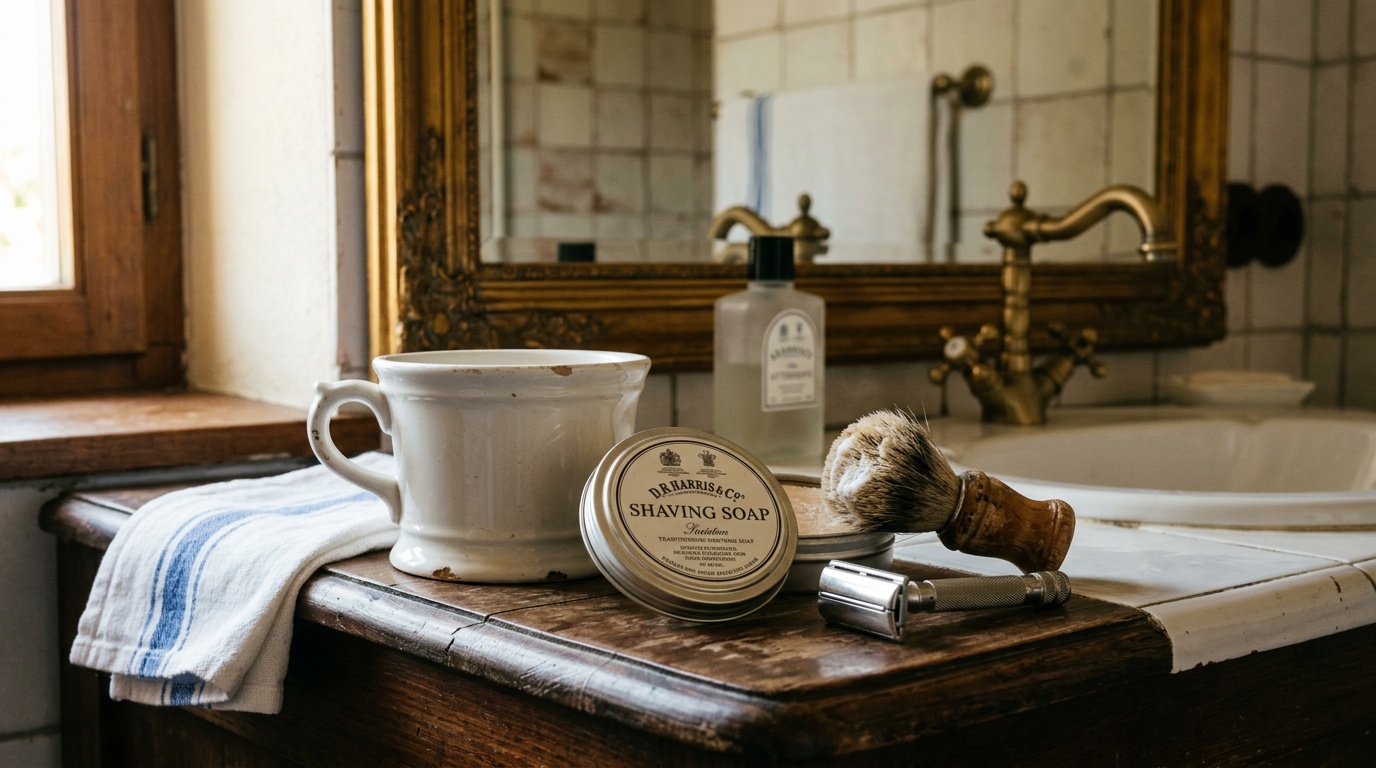
The TSA’s bar soap guidance permits bar soap in both baggage types. A genuinely hard shaving puck fits that solid-soap category; it does not become a liquid because you later add water and work it with a brush. A solid stick follows the same reasoning. There is no 100 ml liquids restriction on a solid bar.
Soft artisan soaps are the awkward middle ground. Wet shavers sometimes call them ?croaps,? meaning a texture between cream and soap. TSA does not publish a firmness scale for shaving products. If yours spreads like paste, pack it under the liquids rule. That is a conservative packing judgment, not a claim that every soft soap has an official classification.
A tub is not automatically a liquid, and a product called a puck is not automatically solid. Consider what is actually inside. For an uncertain formula, use a container no larger than 100 ml in your liquids bag, check it, or ask TSA about the specific product before departure. The screening officer makes the final checkpoint decision.
| Shaving item | Carry-on approach | Checked-bag approach |
|---|---|---|
| Hard soap puck or solid stick | Allowed outside liquids bag | Allowed; contain soap residue |
| Soft, paste-like shaving soap | Conservatively treat as a cream: 100 ml maximum container in liquids bag | Pack securely against leakage |
| Non-aerosol cream or gel | 100 ml maximum container in liquids bag | Larger containers can go here |
| Aerosol shaving foam or gel | 100 ml maximum container in liquids bag; protect nozzle | FAA individual and aggregate limits apply; protect nozzle |
These are U.S. TSA screening rules alongside applicable FAA restrictions. For an international itinerary, check the authority at each departure or connecting airport where you will pass security, plus your airline’s baggage rules. A U.S. outbound screening decision does not establish the rules for your return.
Shaving cream, foam, and aerosols: two limits to understand
The carry-on liquids rule
Under the TSA’s 3-1-1 rule, liquids, gels, aerosols, creams, and pastes must be in containers holding no more than 3.4 fluid ounces, or 100 ml. They must fit together in one clear, quart-size, zip-top bag per passenger. Your shaving cream shares that space with toothpaste, aftershave, and other liquid toiletries.
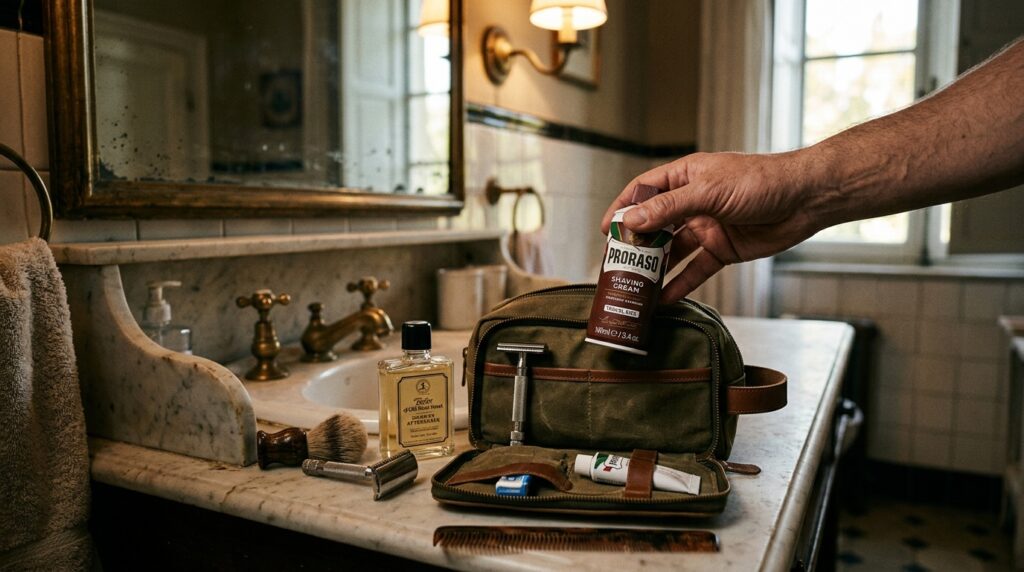
Container capacity matters. A nearly empty 150 ml cream tube remains oversized for carry-on screening. Transfer non-aerosol cream into a suitable smaller container before leaving home, or buy a correctly sized tube. Do not attempt to decant a pressurized aerosol.
Also distinguish weight from volume. An artisan soap marked ?4 oz? may be labeled by net weight. That label alone does not tell you the tub’s capacity in milliliters. This matters when the contents are paste-like and you are relying on the liquids allowance.
The checked-baggage aerosol allowance
TSA permits aerosol shaving cream, subject to the carry-on liquid limit and applicable FAA restrictions. Ordinary personal shaving foam is not automatically prohibited because its can is pressurized.
The FAA’s medicinal and toiletry article rules limit each covered container to 0.5 kg or 500 ml, and the combined covered articles to 2 kg or 2 L per person. The listed equivalents are 18 ounces or 17 fluid ounces individually, and 70 ounces or 68 fluid ounces combined. Protect aerosol release buttons with caps or another suitable means against accidental discharge.
That total includes other covered toiletries, not just shaving cream. Check the whole kit. Keep cans away from heat, follow their labels, and leave damaged or leaking containers behind. A plastic bag can contain a mess; it does not replace nozzle protection.
Choose a travel soap you already know how to lather
My preference is a hard puck or stick I have already used at home. Saving liquids-bag space helps, but reliable lather matters more. A tiny unfamiliar soap that needs repeated loading is poor compensation for leaving a dependable puck behind.
Test the travel setup before departure: soap, brush, container, and face lathering if you normally use a bowl. A shallow container should leave enough clearance for the brush to load without catching its handle on the rim. A solid stick can eliminate the bowl entirely, provided you like applying soap directly to a damp beard.
Hotel hand soap may clean skin, but it is not necessarily formulated to maintain shaving lather and glide. Keep a dedicated shaving soap if that is what your face tolerates. One familiar soap is enough for most trips; bringing several scents adds bulk and more wet containers to manage.
As an Amazon Associate, I earn from qualifying purchases.
For containment, a travel soap case with a removable drain tray is useful if it fits your puck. Check the internal dimensions and closure. Drain holes help on a hotel counter, but an open-draining case can leak inside luggage.
Pack for the damp trip home, too
A dry puck on departure is straightforward. The return journey usually involves a wet brush, a softened soap surface, and a checkout deadline. Give everything drying time before sealing the kit. Shaving the evening before an early departure often makes that easier.
- Empty standing water. Pour water off the soap after loading; do not leave it soaking until checkout.
- Let the surface dry. Leave the container open somewhere clean and ventilated while you finish packing.
- Separate soap from metal. Keep the puck in its own case, away from the razor and spare hardware.
- Contain residual moisture. If the soap must travel damp, close its case and use a separate leak-resistant pouch. Reopen it at your destination.
- Rinse and dry the brush. Shake out water gently, blot with a towel, and allow airflow. Unpack it promptly after arrival.
Do not microwave or bake a soap to make it ?solid enough? for screening. You can alter the formula, damage the container, and still have an uncertain product. Start with a hard soap or use the liquids allowance.
A ventilated shaving brush travel tube can protect a knot from being crushed. Choose one with room around the bristles. Ventilation helps, but a tube buried in a closed wash bag cannot substitute for drying the brush outside the bag.
Check the razor separately: soap permission does not cover blades
A safety razor can pass TSA screening without its blade. Remove the blade before entering the checkpoint. Loose double-edge blades belong in checked baggage, securely protected, or you can obtain compatible blades after arrival. TSA officers will not remove a blade for you.
Disposable and cartridge razors are generally permitted in carry-on baggage. Traditional straight razors belong in checked baggage, with the edge securely protected. Consult TSA’s travel tips for razor distinctions and our straight razor travel guide for packing considerations.
Before leaving, inspect the razor head, blade dispenser, and every small wash-bag pocket. A dispenser may contain used blades in its rear compartment. Factory wrapping does not make loose blades carry-on compliant. For a carry-on-only trip, confirm where you will buy blades instead of assuming the nearest hotel shop carries double-edge replacements.
I leave irreplaceable family razors at home. A familiar, replaceable working razor earns its space in a travel kit without making a lost bag a family loss. Pack a bladeless safety razor where it can be inspected easily, with its parts together and protected from knocks.
Protect old finishes without turning the hotel sink into a restoration bench
My workshop rule is to stop at clean. Chasing mirror brightness on an old plated razor can remove material you cannot put back. A travel cleanup should remove fresh lather and whiskers; worn plating, seized mechanisms, and old corrosion deserve a considered repair at home.
For a sound metal safety razor, remove the blade safely, rinse with warm water, and use mild detergent when needed. A soft nylon toothbrush reaches soap residue around the guard without requiring abrasive polish. Use light pressure and follow the maker’s instructions, especially with unusual coatings or mixed materials.
MERKUR’s care guidance emphasizes drying before storage and gentle cleaning with a soft brush and suitable detergent. Its care FAQ also warns against acids. That supports leaving vinegar descaling experiments out of a travel routine. Avoid abrasive pads and prolonged soaking of an antique whose materials or finish you cannot identify.
Dry the head, threads, and handle before packing. Keep them away from the damp soap case. Do not force a stiff adjustment dial or overtighten a handle because you are rushing. Store a straight razor only after drying it, following its maker’s corrosion-protection instructions; protect the edge without rubbing a towel along it.
Cleaning and disinfection are different jobs
Removing residue does not sterilize a razor. Keep your razor personal, use clean hands, and replace used blades appropriately. A quick splash of aftershave is not a validated disinfection process. If disinfection is needed, use a product and procedure compatible with the razor, including the specified concentration and contact time. Do not improvise an alcohol soak for unknown antique scales, lacquer, or adhesives.
The historical ?Sanitary Shaving? item dates to 1909. ?Soap for safety,? published in 2000, is indexed around hand disinfection and emergency medical services. Neither establishes a modern treatment for vintage razor finishes. They should not be used to justify a homemade sanitizing recipe.
Keep the first shave after a flight comfortable
A small study of skin hydration during long-distance flights followed eight women aged 29?39. Cabin humidity fell below 10% within two hours, and cheek skin capacitance, a hydration-related measurement, decreased by up to 37%. This was not a shaving trial, and the result should not be treated as a prediction for every passenger.
The practical takeaway is modest: if your face feels tight after flying, give it an easier shave. Wet the beard thoroughly, build adequately hydrated lather, and avoid repeated passes over a sore patch. Use a familiar moisturizer if it suits your skin, remembering that it belongs in the liquids bag for carry-on screening. Waiting until morning is also a perfectly sensible choice.
Frequently asked questions
Can you bring shaving cream on a plane?
Yes. For carry-on luggage, use a container no larger than 100 ml and place it in your quart-size liquids bag. Larger containers can go in checked luggage, with applicable toiletry restrictions.
Can you bring all types of shaving foam on a plane?
Ordinary personal-use shaving foams are generally permitted within the relevant limits. Aerosol foam needs nozzle protection; non-aerosol foam still falls under carry-on liquid rules. Permission for shaving foam does not extend to every aerosol product.
Can you bring aerosol shaving cream on a plane?
Yes. Follow the 100 ml carry-on container limit or the FAA’s checked-baggage individual and aggregate limits explained above. Keep the release button protected.
Is it safe to bring shaving cream on a plane?
Ordinary shaving cream is permitted when packed within the rules. Use an intact container, secure its closure or aerosol cap, follow its storage instructions, and protect it from accidental discharge.
Can you bring a razor on a plane?
Yes, depending on its design. Disposable and cartridge razors can generally travel in carry-on bags. A safety razor must have its removable blade taken out before TSA screening; loose blades cannot accompany it in your carry-on.
Can you bring a straight razor on a plane?
Yes, in checked baggage with its edge securely protected. A traditional straight razor is not allowed in carry-on luggage. For light travel, pack a permitted alternative alongside your hard soap and leave the treasured straight at home.
Tradeoffs, uncertainty & affiliate disclosure
A closer shave can require more passes and may reduce comfort. Product feel varies with razor, blade, lather, angle, pressure, beard growth, and personal preference. ClassicBlade does not imply that every mentioned item was purchased, used, measured, or independently tested.
Some links may be affiliate links. ClassicBlade may earn a commission at no added cost to you; commercial links do not stand in for evidence.
Leave a Comment