


The quick take
Verdict, audience & limits
Can You Fly With a Shaving Brush?
My grandfather’s razor started my interest in wet shaving, and 23 years and more than 300 tested razors later, I […]
Who this is for
Readers deciding whether this shaving topic, method, or product category fits their routine and preferences.
What this cannot promise
A universal result, irritation-free shave, medical outcome, or firsthand product test unless that specific use is explicitly documented.
Specifications & source boundary
Model dimensions, materials, blade compatibility, and loading instructions should be checked against the maker’s documentation for the exact product and version. Manufacturer specifications are not independent measurements, and a photograph is not evidence of a product test.
How to read the evidence
Applies only where a specific razor, blade, or product and its conditions are explicitly identified.
Maker-supplied details should be checked against the exact model, market, and version.
A cautiously summarized pattern across identified sources, with disagreement acknowledged.
Background or explanatory framing, not a testing credential or objective measurement.
A subjective choice about feel, cost, convenience, or ritual—not a universal recommendation.
Technique variables
Change one thing. Pay attention.
Lather & preparation
Soften the beard with water, build a comfortably slick lather, and reapply before another pass.
Angle & pressure
Use light pressure and a shallow, familiar angle appropriate to the razor. Do not press harder to compensate for tugging.
Direction & passes
Begin with the grain, use fewer deliberate passes, and let comfort matter more than chasing perfect closeness.
Blade handling
Follow loading instructions, hold only unsharpened sides, and keep cutting edges away from fingers.
Use light pressure, fewer deliberate passes, and stop for pain or persistent irritation. Keep unused blades dry, secure, and away from children and pets. Place used blades in a closed puncture-resistant container and follow local disposal guidance. This is general grooming guidance, not medical advice.
My grandfather’s razor started my interest in wet shaving, and 23 years and more than 300 tested razors later, I still think a good brush earns its place in a travel bag. Yes, you can fly with an ordinary shaving brush in your carry-on or checked luggage. The brush itself is not a liquid or a razor blade. Your shaving cream, loose blades, and the way you pack a damp knot are the parts that need attention.
For a straightforward trip, pack a clean, dry brush in a protective case, use a hard shaving soap or a compliant travel-size cream, and decide where your blades will come from before leaving home. The rules below concern U.S. TSA screening; check the authorities for other departure and connecting airports separately.
As an Amazon Associate, I earn from qualifying purchases.
What belongs in your carry-on shaving kit?
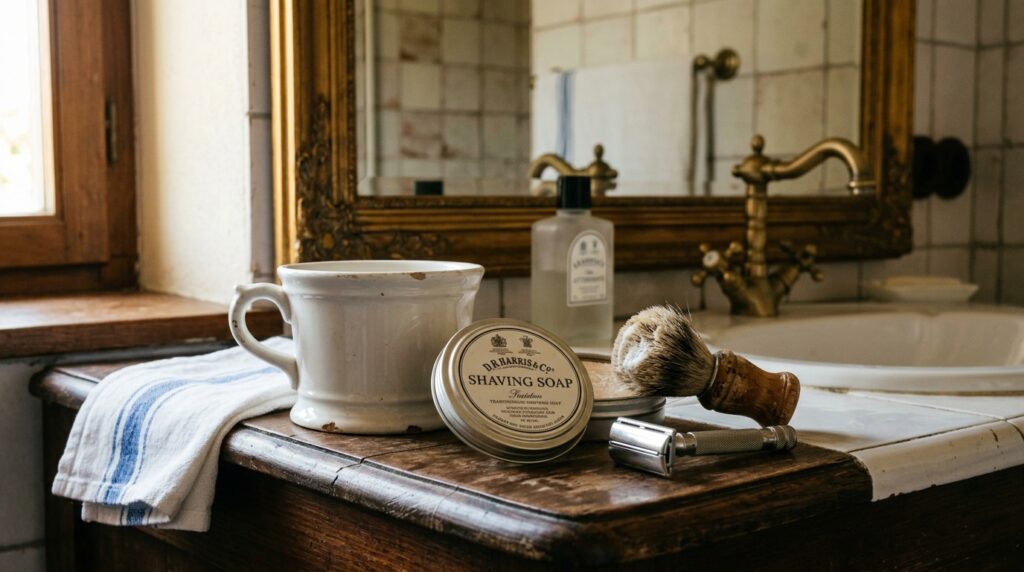
An ordinary synthetic, boar, or badger shaving brush can travel with your toiletries outside the liquids bag. Its handle material does not turn it into a prohibited razor. Expect any item to be available for inspection, and remember that security permission does not protect a fragile handle from a crowded suitcase.
| Shaving item | Carry-on | Checked luggage |
|---|---|---|
| Ordinary shaving brush | Yes; protect the knot | Yes; cushion against crushing |
| Safety razor | Without its removable blade | Yes; secure any sharp edges |
| Loose double-edge or single-edge blades | No | Yes; securely enclosed |
| Disposable or cartridge razor | Yes | Yes; cover the head |
| Electric razor | Yes | Yes, subject to battery precautions |
| Hard shaving soap | Yes | Yes |
| Shaving cream, gel, or foam | Containers no larger than 100 ml/3.4 oz in the liquids bag | Yes; aerosol limits apply |
The relevant TSA references are its entries for safety razors, disposable razors, and electric razors. TSA officers make the final checkpoint decision. Keep your kit accessible instead of burying metal components beneath chargers and cables.
Choose a brush you can dry and protect
My travel judgment is simple: take a modest synthetic brush and leave the irreplaceable brush at home. I value an old turned handle and a well-made natural knot, but an early checkout is a poor setting for preserving either. Synthetic fibers generally dry faster than natural hair, although a dense knot can still retain water around its base.
Choose the case around the brush’s actual dimensions. The knot should enter without folding the tips backward, and the lid should close without pressing down on them. A ventilated shaving brush travel case is useful for protecting the bristles and separating them from the razor. Check internal height and diameter; “travel size” says little about whether your particular brush fits.
Ventilation holes are helpful, but a tube packed tightly inside a zipped wash bag has little airflow. It is still a transport case, not a drying cabinet. With a badger or boar brush, leave enough time between the last shave and packing for the center to dry, not merely the tips.
Wood, older resin, and repaired handles deserve extra cushioning. Pack them away from glass aftershave bottles and loose razor heads. For international travel, an unusual antique handle made from ivory or another regulated wildlife material needs separate customs research; an ordinary brush’s security status does not settle wildlife import rules.
Pack the brush after the shave, not during it
The most useful maintenance happens before the suitcase closes. MÜHLE’s care guidance advises keeping brushes away from persistently damp storage and avoiding closed cases for natural hair until it is completely dry. That is a better foundation than hoping a few ventilation holes will undo hurried packing.
- Rinse out the lather. Use comfortably warm water and gently work water through the center until no visible soap remains. Avoid soaking the entire handle.
- Remove excess water gently. Shake lightly over the basin and blot with a clean towel. Do not wring the knot or grind its tips into the fabric.
- Allow open-air drying. Put the brush somewhere with airflow, away from a radiator or hair dryer. Follow its maker’s storage instructions.
- Pack without compression. Use a case that protects the loft and support the handle so it cannot rattle against other tools.
- Unpack on arrival. Open the case and let the brush finish drying before the next use.
If an early flight leaves no drying time, shave the night before or use your backup razor without the brush that morning. When a damp brush must travel, remove as much moisture as possible and keep the enclosed period short. Do not leave it sealed in the wash bag for the rest of the holiday.
A separate small microfiber cleaning cloth is handy for blotting a handle and drying razor parts. Keep it clean: a cloth carrying grit can mark a polished surface. Pack a damp cloth separately from dry metal tools.
Bring the safety razor, but make a blade plan
A safety razor with its removable blade installed does not belong in a carry-on. Remove the blade before going to the airport. The blade-free razor may travel in cabin baggage under TSA guidance; loose replacement blades must go in checked baggage. A paper wrapper does not make a loose blade acceptable at the checkpoint.
For carry-on-only travel, arrange to buy compatible blades at your destination. Check availability first if your razor uses an uncommon format. Alternatively, bring a cartridge or disposable razor as the whole-trip solution or as a backup. TSA permits those enclosed cutting heads in carry-on luggage, including replacement cartridges.
For checked baggage, keep fresh blades in their protective packaging inside a secure holder. Used blades need a puncture-resistant, closed container rather than a tissue or loose pocket. A traditional straight razor also belongs in checked baggage, with its edge protected and its case secured against opening.
Protect an old razor’s finish and threads
My workshop rule is to identify the material before choosing the cleaner. A vintage plated razor, a lacquered finish, and bare stainless steel should not automatically receive the same treatment. Abrasive polish removes material; repeated polishing can thin delicate plating, especially along raised edges. Acidic cleaners and long chemical soaks are poor guesses when the underlying metal or finish is unknown.
For a sound personal-use razor, routine travel cleaning usually means mild soap, a soft brush where appropriate, a thorough rinse, and careful drying. Do not use a hotel descaler or aggressively scrub a discolored patch just before packing. Discoloration may be worn plating rather than removable dirt.
A three-piece razor can travel with its components separated in individual padded pockets, making the empty head easier to inspect. Keep the threaded post from banging against other metal, and do not force a vintage mechanism apart. A fitted case should support the tool without loading the guard teeth or squeezing the adjustment mechanism. Preserve the geometry as carefully as the shine.
Shaving cream and soap: pack according to consistency
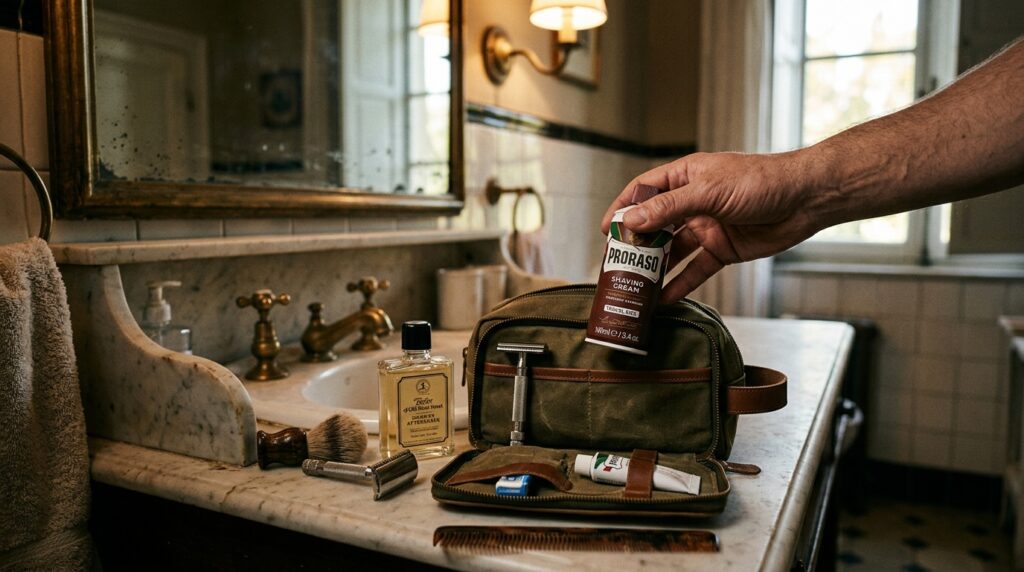
Shaving cream, gel, and aerosol foam fall under the carry-on liquids rules. Use containers with a capacity of 100 ml/3.4 oz or less, all fitting in your single clear, quart-size resealable liquids bag. A nearly empty 150 ml tube is still an oversized container. These requirements come from TSA’s liquids rule.
A firm soap puck or genuinely solid shave stick avoids that liquids allowance. TSA lists bar soap as permitted in both bags. Soft shaving soaps complicate the distinction: the word “soap” on the label does not make a creamy paste solid. My packing rule is to treat a scoopable cream-like soap as a paste and put a small container in the liquids bag. That is a conservative choice, not an official finger-scoop test.
How to pack shaving cream without leaks
Use a tightly capped travel tube, or transfer non-aerosol cream into a clean, compatible, clearly capacity-marked travel container. Wipe the threads before closing and avoid filling a refillable pot to overflowing. Keep it in the liquids bag, separated from the brush and razor. Transfer cream with a clean utensil rather than repeatedly dipping wet fingers into the supply.
Never try to decant a pressurized aerosol can. Buy a compliant travel can for cabin baggage. Larger aerosol shaving cream can go in checked luggage within the FAA medicinal and toiletry limits: each container no larger than 500 ml or 0.5 kg, with a combined per-person allowance of 2 L or 2 kg for covered articles. Protect the nozzle with its cap or another suitable guard. The allowance includes other covered toiletries, not just shaving foam.
Drain the soap dish before closing it, then open it at the hotel. A good hard puck loses its travel advantage if you carry it in a tin full of water.
Clean equipment without turning the hotel sink into a restoration bench
Cleaning removes residue; it does not establish sterility. For your own maintained brush, thorough rinsing and drying are sensible daily care. A quick alcohol splash does not prove that an unknown secondhand knot is disinfected, and soaking can be incompatible with adhesives, coatings, or handle materials. Follow material-specific manufacturer advice when disinfection is actually required.
The historical concern is real but easily exaggerated. The review Anthrax Cases Associated with Animal-Hair Shaving Brushes describes outbreaks linked to inadequately disinfected animal hair, particularly around World War I. Its full CDC publication says modern animal-hair brushes are unlikely sources and advises against attempting hazardous home disinfection of vintage brushes. That is a reason to understand an antique’s provenance, not to boil your current travel brush.
Keep the shave familiar as well as the equipment clean. The review Insights into shaving and its impact on skin discusses skin problems, nicks, and hair removal mechanics; it does not establish that a particular travel brush prevents irritation. A trip is a poor occasion to combine a new blade, unfamiliar soap, and extra pressure while rushing.
If you have recently had facial skin surgery, ask your treating clinician about both shaving and flying. A survey of 125 respondents about travel after skin surgery found advice varied with the procedure and location. It is postoperative research, not evidence for a waiting period after an ordinary shave.
Frequently asked questions
| Can you fly with a shaving brush? |
Yes. An ordinary shaving brush can go in carry-on or checked luggage. Pack it clean and dry, with room around the bristles so the case cannot crush them. |
|---|---|
| Can you fly with a safety razor? |
Yes. For TSA carry-on screening, remove its blade before reaching the checkpoint. Loose blades belong in checked baggage, securely protected, or must be purchased after arrival. |
| Can you put a shaving razor in your carry-on? |
Disposable, cartridge, and electric razors are permitted. A removable-blade safety razor must be blade-free. Traditional straight razors go in checked luggage. |
| Can you bring shaving cream on a plane, and how should you pack it? |
Yes. Carry-on containers must be 100 ml/3.4 oz or smaller and fit in your quart-size liquids bag. Tighten caps and protect aerosol nozzles. Checked aerosols remain subject to FAA quantity limits. |
| Can you bring shaving soap on a plane? |
Yes. Solid soap can go in either bag. Treat cream-like shaving soap as a paste for carry-on packing, using a compliant container in the liquids bag. |
| What about shaving scissors or beard trimmers? |
TSA permits carry-on scissors with blades measuring less than 4 inches from pivot to tip. Beard trimmers are generally permitted; protect their cutting head and prevent accidental activation. Spare lithium batteries belong in carry-on baggage with terminals protected. |
For those last accessories, check TSA’s scissors guidance and the FAA PackSafe battery guidance. Then give the kit one final inspection: blade accounted for, cream capped, brush dry, and no loose metal rubbing against a finish worth preserving.
Tradeoffs, uncertainty & affiliate disclosure
A closer shave can require more passes and may reduce comfort. Product feel varies with razor, blade, lather, angle, pressure, beard growth, and personal preference. ClassicBlade does not imply that every mentioned item was purchased, used, measured, or independently tested.
Some links may be affiliate links. ClassicBlade may earn a commission at no added cost to you; commercial links do not stand in for evidence.
Leave a Comment