

The quick take
Verdict, audience & limits
Can I Take a Razor on a Plane Internationally?
My grandfather’s razor started my interest in wet shaving, and 23 years and more than 300 razors later, I still […]
Who this is for
Readers deciding whether this shaving topic, method, or product category fits their routine and preferences.
What this cannot promise
A universal result, irritation-free shave, medical outcome, or firsthand product test unless that specific use is explicitly documented.
Specifications & source boundary
Model dimensions, materials, blade compatibility, and loading instructions should be checked against the maker’s documentation for the exact product and version. Manufacturer specifications are not independent measurements, and a photograph is not evidence of a product test.
How to read the evidence
Applies only where a specific razor, blade, or product and its conditions are explicitly identified.
Maker-supplied details should be checked against the exact model, market, and version.
A cautiously summarized pattern across identified sources, with disagreement acknowledged.
Background or explanatory framing, not a testing credential or objective measurement.
A subjective choice about feel, cost, convenience, or ritual—not a universal recommendation.
Technique variables
Change one thing. Pay attention.
Lather & preparation
Soften the beard with water, build a comfortably slick lather, and reapply before another pass.
Angle & pressure
Use light pressure and a shallow, familiar angle appropriate to the razor. Do not press harder to compensate for tugging.
Direction & passes
Begin with the grain, use fewer deliberate passes, and let comfort matter more than chasing perfect closeness.
Blade handling
Follow loading instructions, hold only unsharpened sides, and keep cutting edges away from fingers.
Use light pressure, fewer deliberate passes, and stop for pain or persistent irritation. Keep unused blades dry, secure, and away from children and pets. Place used blades in a closed puncture-resistant container and follow local disposal guidance. This is general grooming guidance, not medical advice.
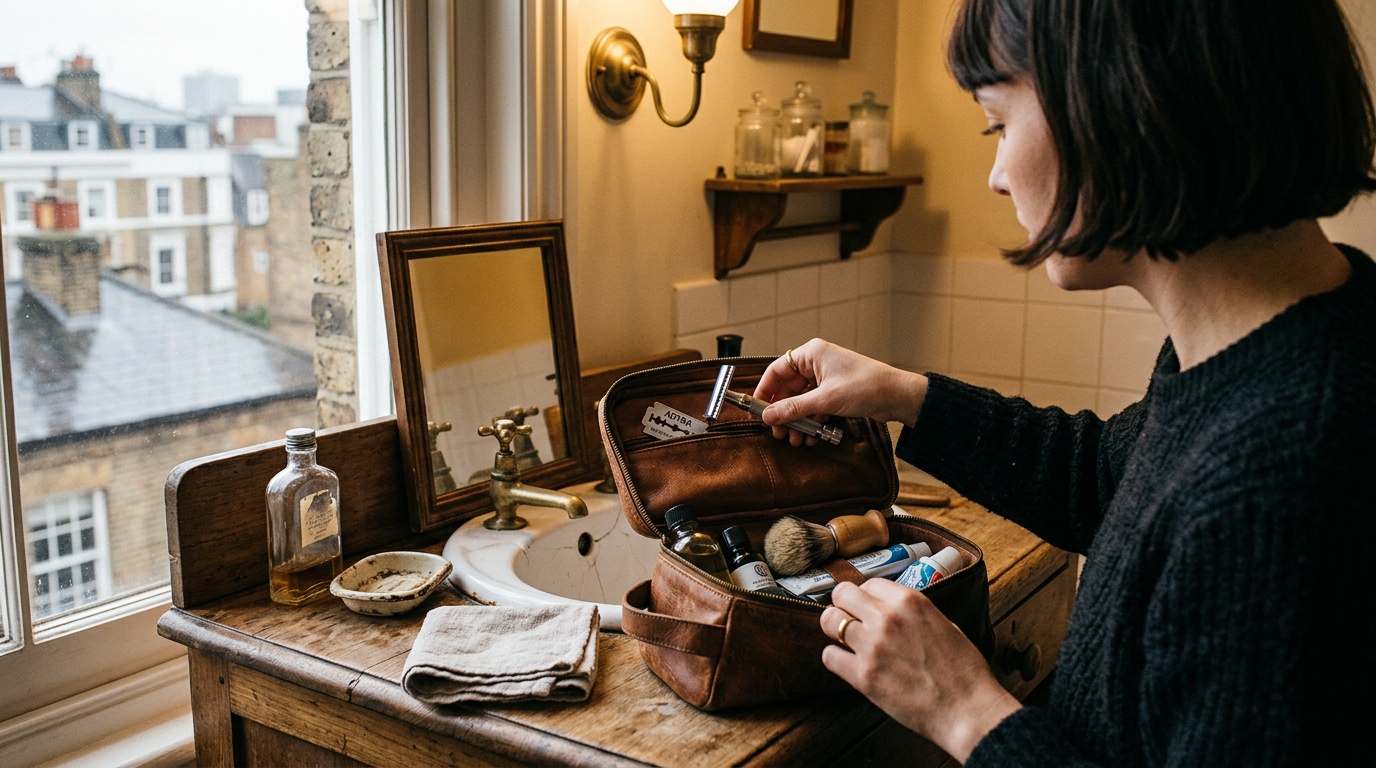
My grandfather’s razor started my interest in wet shaving, and 23 years and more than 300 razors later, I still think a well-made safety razor deserves a place in a travel kit. But cleaning old soap out of a razor teaches you to inspect what is actually inside the head. Before a flight, that means checking for a forgotten blade.
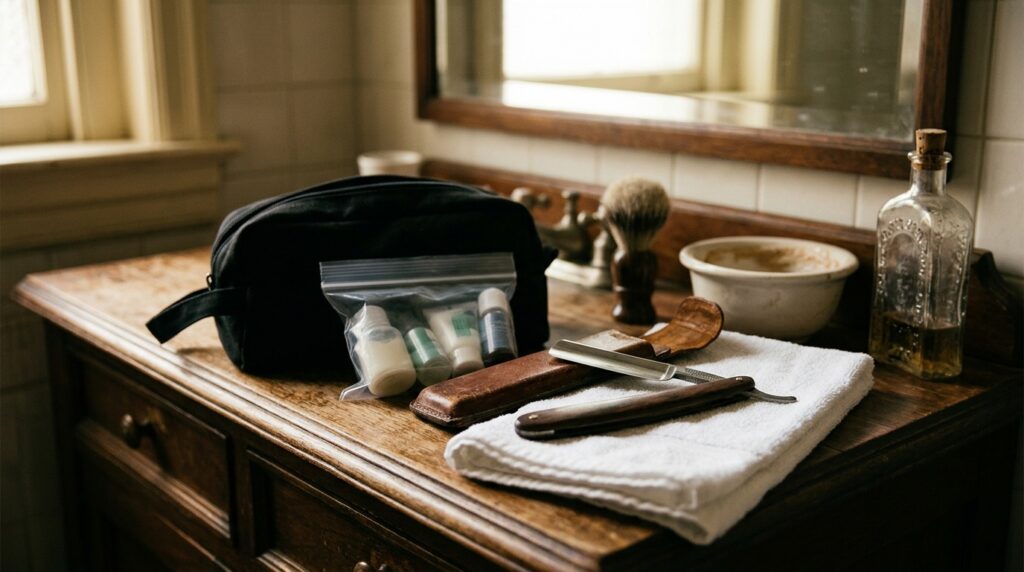
Can I take a razor on a plane internationally? Yes, but the type of razor and the security rules at each departure airport determine where it can travel. Disposable and cartridge razors are usually the easiest carry-on choices. At U.S. TSA checkpoints, a safety razor can travel in your carry-on with the blade removed; loose replacement blades belong in checked baggage. A traditional straight razor belongs in checked baggage too. Those U.S. rules are a starting point, not worldwide permission.
As an Amazon Associate, I earn from qualifying purchases.
1. Identify your razor before choosing a bag
The confusing word is ?removable.? A cartridge that clicks off its handle is different from a double-edge blade that lifts out of a safety razor. With a cartridge, the cutting blades remain enclosed in the cartridge assembly. With a traditional safety razor, you can remove the actual thin steel blade.
This table summarizes packing at U.S. TSA checkpoints. Check the equivalent guidance for the rest of your route before applying it overseas.
| Razor or blade type | Carry-on at U.S. checkpoints | Checked baggage |
|---|---|---|
| Disposable razor | Allowed | Allowed; protect the head |
| Cartridge razor and replacement cartridges | Allowed | Allowed; protect the heads |
| Safety razor with no blade fitted | Allowed | Allowed |
| Safety razor with a blade fitted | Not allowed | Allowed; secure the cutting edges |
| Loose double-edge or single-edge razor blades | Not allowed | Allowed; securely contain them |
| Traditional straight razor | Not allowed | Allowed; sheath or securely wrap it |
| Electric shaver | Allowed | Check applicable battery requirements |
TSA explicitly requires removing the safety-razor blade before entering the checkpoint; officers are not authorized to remove it for you. Its official permitted-items list also explains the requirement to protect sharp objects in checked baggage.
Do not assume a folding shavette becomes carry-on acceptable simply because you remove its half blade. It resembles a straight razor and needs its own classification from the relevant authority. Likewise, a modern razor taking several loose blades does not become a cartridge razor because its head pivots. Identify the blade system, not the marketing name.
2. Check your departure, connections, and return flight
?International? does not create one shared airport rulebook. Flying from the United States to another country starts with TSA screening, but your return flight normally begins under that country’s security system. A connection can introduce another screening checkpoint, especially when changing terminals or leaving the secure area.
Canada’s CATSA guidance on safety razors and loose blades explicitly permits a safety razor in carry-on when its blade has been removed. Straight razors and loose removable blades are not permitted in carry-on. CATSA separately lists disposable razors and blade cartridges as permitted.
The UK government’s personal-items guidance allows fixed-cartridge razor blades, including disposable razors, in hand luggage and hold luggage. Do not stretch that wording into permission for a loaded double-edge razor. If an empty safety razor is not clearly covered by your airport’s guidance, ask the airport about that exact design before packing it.
For any other country, look up the departure airport or national aviation-security authority, then check your airline’s baggage conditions. Send a model name or photograph if the design is unusual. The UK Civil Aviation Authority’s packing advice makes clear that airports can reject items they consider dangerous even when those items are not specifically listed.
My judgment call is simple: an irreplaceable family razor stays home when the route leaves room for doubt. A saved rules page can help explain an empty razor, but it cannot guarantee admission through security or recover a keepsake from a lost suitcase.
3. Choose a realistic blade plan
If you are traveling with carry-on only
Take an empty safety razor only after checking your route, and arrange blades at the destination. Confirm a nearby shop actually stocks your blade format. Standard double-edge blades may be easier to source than injector, GEM-style, or proprietary single-edge blades, but availability is not something to gamble on before an early meeting.
A cartridge razor makes a sensible backup. You can respect old-school shaving and still choose a convenient tool for a short trip. Use a familiar cartridge rather than experimenting with an unfamiliar blade and hurried technique on your first morning away.
Check every pocket of the wash bag before departure. A sealed tuck of blades is still a pack of blades, and a used-blade compartment in a dispenser still contains sharp steel. Neither the paper wrapper nor the fact that a blade is blunt makes it carry-on compliant.
If you have checked luggage
Pack replacement blades in their original dispenser or wrapping inside a rigid, secure container that prevents their edges from reaching anyone handling the bag. The paper sleeve alone is poor protection against crushing. Keep the razor unloaded for packing, even when a loaded one is permitted in the hold; it makes unpacking and cleaning less awkward.
Plan the return journey before buying a large supply abroad. Spare blades need the same baggage arrangement on the way home. For used blades, a travel razor blade disposal container provides temporary containment. Choose one with a secure closure, follow local disposal guidance, and never put it in carry-on while it contains blades. Do not leave loose blades in a hotel wastebasket.
4. Pack an old razor against pressure and abrasion
A razor surviving seventy years of shaving does not mean it will enjoy rattling against nail clippers in a suitcase. The vulnerable places are often the cap corners, open-comb teeth, handle threads, and thin decorative plating. A soft pouch prevents some rubbing; a rigid case also helps resist pressure.
Choose a hard-shell safety razor travel case by its internal dimensions and support, not just its appearance. The lid should close without pushing on the razor head. Clean, dry padding should prevent movement without forcing delicate teeth into foam or letting the handle knock against the cap.
For a three-piece razor, either secure the empty assembled razor or cushion its parts separately. Do not overtighten the handle to make it ?travel secure.? With a butterfly razor, remove the blade and close the doors normally; forcing apart its mechanism for packing is unnecessary. An original vintage presentation case may deserve preservation itself, particularly if its lining is brittle or stained.
One workshop rule I carry into packing is to treat remaining plating as something you cannot replace with a cloth. Grit trapped in a pouch can scratch it, and repeated polishing can remove more finish. Wash a dirty pouch and replace crumbling padding before putting a restored razor inside.
Keep the case accessible if the empty razor needs inspection. At the hotel, unpack over a towel rather than a bare tiled floor. A dropped head can damage alignment or threads in a moment.
5. Clean before travel, then keep the kit dry
The useful preflight maintenance is modest: remove the blade, clean away soap, rinse, and dry. Do this the evening before packing when possible. A razor that looks dry on top can still hold water underneath its baseplate or around a butterfly mechanism.
For an ordinary metal razor in sound condition, use lukewarm water, a little mild dish detergent, and a soft toothbrush dedicated to cleaning. Brush gently around the underside of the cap and accessible threads. Follow the maker’s care instructions, and be more cautious with loose plating, decorative coatings, or handles made from wood or other unfamiliar materials.
A non-abrasive microfiber cleaning cloth is useful for blotting the unloaded razor. Use a clean cloth without polishing compound, then allow sheltered areas to air-dry. Do not rub or wipe along a blade’s cutting edge.
A hotel bathroom is a poor restoration bench
Stubborn white residue is not an invitation to pour vinegar over an unknown finish. Nor should toothpaste, a scouring pad, or metal polish become an improvised cleaning kit. The M?HLE Companion care manual, for example, warns against acidic cleaners and vinegar, as well as excessive tightening and drops. Older razors need care matched to their particular materials, not a stronger version of every cleaning method.
I would rather bring home a little mineral residue than remove original finish trying to make a razor sparkle before checkout. Preservation means knowing when to stop. A discolored patch may be exposed base metal rather than dirt; scrubbing cannot put the plating back.
Cleaning and disinfection serve different purposes
Removing soap and whiskers does not sterilize a razor. Equally, a splash of aftershave or hand sanitizer is not a validated disinfection process. For a razor used only by you, travel maintenance should center on regular cleaning, drying, and a fresh blade when needed.
If a secondhand purchase or shared razor needs disinfection, complete that work before travel using a suitable product and its labeled dilution, contact time, and material restrictions. Do not assume a prolonged alcohol or disinfectant soak is safe for every coating, adhesive, or vintage handle. When the material is uncertain, get appropriate restoration advice before immersion.
After the morning shave, drain and dry the equipment before closing the bag. If checkout forces you to pack damp gear briefly, open it and finish drying at the next stop. A sealed leather pouch is storage, not a drying rack.
6. Keep shaving cream and aftershave within the liquid rules
An acceptable razor does not make the rest of the wash bag acceptable. At U.S. checkpoints, shaving cream, gels, pastes, and aftershave fall under the liquid rules: containers must hold no more than 3.4 ounces or 100 milliliters and fit together in one clear, quart-sized resealable bag per passenger. See TSA’s travel guidance. A half-empty oversized container still has an oversized capacity.
A genuinely solid shaving-soap puck can simplify packing. Soft shaving soap with a paste-like consistency is less straightforward, so pack it within the liquid allowance unless the relevant authority confirms otherwise. Let the puck drain before closing its container; keeping wet soap beside a carefully dried razor defeats the effort.
Liquid screening can differ on the return leg. The UK government’s current liquid guidance says limits depend on the airport, with most restricting containers to 100 milliliters. Check every airport where you will pass security rather than relying on what one new scanner allowed.
A large bottle of disinfectant adds weight, leak risk, and another product whose carriage rules need checking. Finish restoration at home and pack a small daily-care kit that you can actually dry between stops.
7. Frequently asked questions
Can I take a safety razor internationally without blades?
U.S. TSA and Canadian CATSA guidance permit an empty safety razor in carry-on baggage. Check other departure and transfer authorities individually. Remove the blade before arriving at security and inspect the bag for spare blades.
Are unopened razor blades allowed in hand luggage?
Unopened loose double-edge and single-edge blades do not get an exemption under TSA or CATSA rules. Replacement cartridges with enclosed cutting blades are a different category. Packaging alone does not decide which rule applies.
Does a protective cover make a straight razor carry-on safe?
No. A sheath or closed handle protects against accidental contact; it does not change the razor’s classification. Pack a traditional straight razor securely in checked baggage and verify your route’s requirements.
What if security questions an empty safety razor?
Explain that the blade has been removed and show the relevant official guidance if helpful. Follow staff directions, and do not reach into the bag or dismantle the razor without being asked. Allow extra time for inspection, especially with an unfamiliar design.
What would I pack for a short international trip?
A replaceable razor, a protective case, a modest amount of shaving soap, and a clean drying cloth. With carry-on only, I would use a cartridge or arrange destination blades for an approved empty safety razor. The grandfather’s razor stays where I can care for it properly, ready for the first unhurried shave back home.
What I Would Check Before Buying a Full Box
- How dense your beard is and whether mild blades usually leave you doing extra cleanup passes.
- Whether your current razor already shaves on the mild side, because that can make a comfort-first blade feel too soft.
- How much you value skin comfort versus raw first-pass efficiency.
- Whether it makes more sense to test a small tuck first instead of committing to a 100-pack.
That short checklist usually tells me faster than online hype whether a blade is actually worth testing in a specific shave setup.
Tradeoffs, uncertainty & affiliate disclosure
A closer shave can require more passes and may reduce comfort. Product feel varies with razor, blade, lather, angle, pressure, beard growth, and personal preference. ClassicBlade does not imply that every mentioned item was purchased, used, measured, or independently tested.
Some links may be affiliate links. ClassicBlade may earn a commission at no added cost to you; commercial links do not stand in for evidence.


Leave a Comment